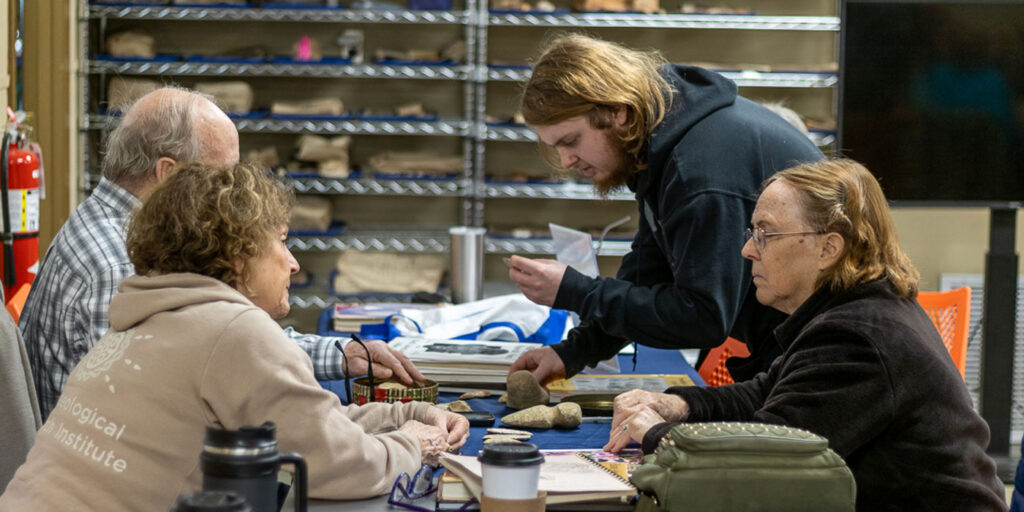
A mammoth tooth. An 18-inch cephalopod pulled from a creek bed. A pottery shard that might be centuries old. Every second Saturday of the month, people walk through the doors of the Archaeological Research Institute in Lawrenceburg, Indiana carrying objects that stopped them in their tracks. Through ARI’s free Artifact, Rock, and Fossil Identification Days, our team helps curious minds of all ages uncover the stories behind these remarkable finds. No geology degree required. No appointment needed.
Identification Day is held every second Saturday of the month from 9:30 a.m. to 2:00 p.m. at ARI’s public archaeology base camp (126 West High Street in Lawrenceburg, Indiana).
Sometimes it’s a strange rock found while gardening. Sometimes it’s an arrowhead that’s been sitting in a family collection for generations. Other times it’s a fossil discovered during a weekend creek walk. Visitors come from across the region for fossil identification and artifact identification, bringing everything from Ice Age fossils to family heirlooms and unusual geological specimens. Our staff and volunteers examine each visitor’s item and help place it on a timeline of history.
This event is so much more than just show-and-tell. It’s a doorway into the deeper story of this region, offering a chance to understand how the soil beneath your feet holds millions of years of history waiting to be discovered.
The name says it all: we welcome artifacts, rocks, and fossils. Whether you’ve dug up something that looks human-made or found something that looks ancient and organic, ARI is the place to bring it.
Our region has an extraordinary natural and human history. Southeast Indiana sits on top of some of the richest Ordovician fossil deposits in North America — ancient seabeds that preserve the remains of creatures that lived roughly 450 million years ago. At the same time, the Ohio River Valley was home to Indigenous cultures for thousands of years, leaving behind tools, pottery, and earthworks that continue to surface in fields, riverbanks, and backyards today.
Whether it’s something you’ve just uncovered or an object that’s sparked questions for years, we’d love to help you learn more about it.
Every Identification Day brings surprises. Most visitors arrive wondering if they’ve found something interesting. Occasionally, they walk in carrying something extraordinary. When Mike Mages arrived at an ARI Identification Day with a mammoth tooth, it was one of those moments.
Mammoth teeth are among the most impressive fossils a person can encounter. The molars of a Columbian mammoth, the species most commonly found in Indiana, can reach 9 to 12 inches in length in their final growth stage, and are composed of a series of thick enamel plates separated by cementum, giving them a distinctive washboard-like surface built for grinding vast quantities of vegetation. Each tooth is a record of the animal’s age and diet, and Indiana is one of the most productive states in the country for mammoth and mastodon remains, with fossils documented in nearly every county.
The Columbian mammoth was a warm-climate cousin of the woolly mammoth — larger, less hairy, and far more common in the American Midwest. Indiana’s glacial landscape, with its peat bogs, wetlands, and ancient lake beds, created ideal conditions for preservation. Mammoth teeth are occasionally turned up during construction, pond excavation, and agricultural work, most often by people who have no idea what they’re looking at until a professional takes a look.
Mike’s find is a reminder that Ice Age giants walked the same ground we live on — and that their remains are still out there, waiting.
When Abe Strassell and his family waded into a creek in Milan, Indiana, they weren’t expecting to pull out a piece of the ancient ocean floor. But that’s exactly what an 18-inch cephalopod fossil represents — a creature from a time when all of Indiana was submerged beneath a warm, shallow inland sea.
The Strassell family brought their remarkable find to ARI’s Identification Day on April 11, 2026, and it’s the kind of specimen that makes our staff’s eyes light up.
Cephalopods are the ancient relatives of today’s squid, octopus, and nautilus. During the Ordovician period — roughly 450 to 485 million years ago — straight-shelled cephalopods called orthocones were apex predators of the shallow inland seas that covered what is now the American Midwest. Unlike modern squid, which have an internal shell, these animals lived inside long, conical external shells divided into chambers. The animal occupied the largest forward chamber, with its head and tentacles extending outward, while a tube called a siphuncle ran through the interior chambers to regulate buoyancy — much like a living submarine.
An 18-inch specimen is a significant find. Most creek-found cephalopods in this region are fragments, worn smooth by water and time. A well-preserved example of this size speaks to both the ancient abundance of these creatures in our seas and to the remarkable fossil richness still hidden in the creek beds, road cuts, and exposed limestone of southeastern Indiana and southwestern Ohio.
The Strassells found their piece of the Ordovician sea right in a local creek — proof that you don’t need a permit or a plane ticket to make a remarkable discovery. You just need to look down.
ARI’s Identification Days are free and open to everyone, but they serve a purpose that extends beyond a Saturday morning conversation. When community members bring in their finds, they’re contributing to a living record of the region’s natural and human history.
Items that are identified and documented through fossil identification and artifact identification efforts help researchers understand distribution patterns, track find locations, and fill gaps in the scientific record that professional excavations alone could never cover.
The Ohio River Valley is one of the most archaeologically and paleontologically significant regions in North America. Every arrowhead, fossil fragment, and unusual rock in someone’s garage represents a data point — and ARI is here to help connect those dots.
But equally important is what happens on the human side of the table. When someone walks in holding something they found and walks out understanding what it is and why it matters, archaeology stops being an abstract academic pursuit and becomes something personal. Something local. Something theirs.
That’s what ARI is here for.
Artifact, Rock, and Fossil Identification Day is held every second Saturday of the month, 9:30 a.m. – 2:00 p.m., at The Archaeological Research Institute (126 West High Street, Lawrenceburg, IN 47025).
The event is free and open to all ages. Bring your finds and your curiosity! Our team will bring the expertise.
For families looking for educational Lawrenceburg, Indiana events, Identification Day offers a unique opportunity to connect with the area’s archaeological and natural history. Add Identification Day to your calendar. We’ll see you on the second Saturday!
University and School Partnerships
Interested in sending your students to our field school? Contact us today to learn about one of our many opportunities for student learning.