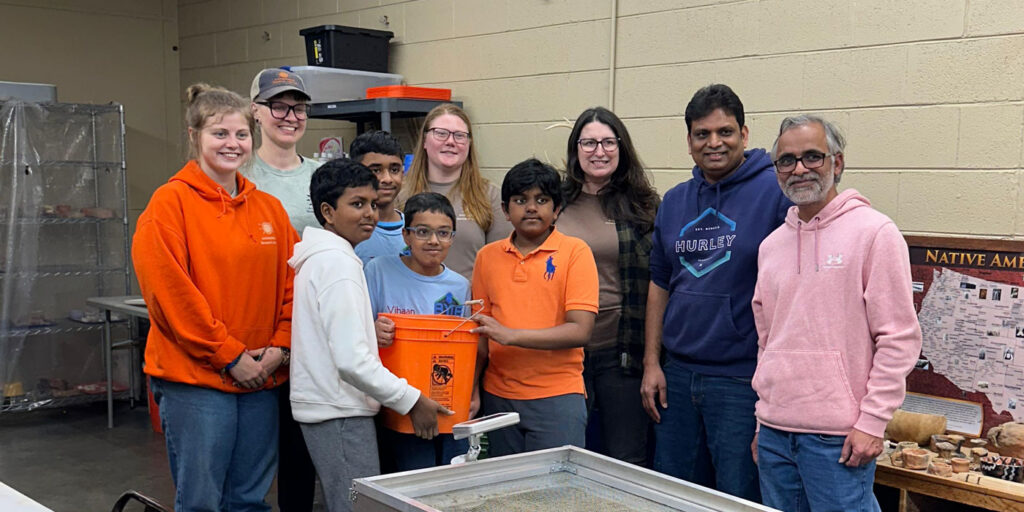
When 350 students across the country picked up a LEGO brick this season, they weren’t just building robots — they were tackling real challenges faced by real archaeologists. Thanks to a unique partnership with ARI, teams competing in the 2025–2026 FIRST® LEGO® League UNEARTHED™ season had something most competitors didn’t: direct access to professional archaeologists who opened their field sites, their expertise, and their toolboxes.
The result? A wave of innovative, student-designed archaeology tools that could help improve the way fieldwork is done.
FIRST® LEGO® League (FLL) is an international STEM competition for students that combines robotics, research, and problem-solving. As one of the world’s leading STEM education programs, FLL encourages young innovators to explore complex challenges and develop practical solutions that can make a real impact.
Each year, teams tackle a new theme — and this season, that theme hit close to home for ARI. UNEARTHED™ challenges teams to explore how artifacts and ancient innovations connect us to the people and ideas that came before us. For their Innovation Projects, students were asked to identify a genuine challenge facing archaeologists today and design a solution. ARI stepped in as a partner organization, offering everything from virtual consultations to field visits and hands-on feedback to teams across multiple states.
ARI educated and mentored over 350 students on FLL robotics teams spanning locations including:
Teams worked directly with ARI staff including Amanda Duncan and Forrest Schmitt, who provided feedback on prototypes and walked students through real excavation challenges to give them the context they needed to build meaningful solutions. Through this partnership, students gained firsthand insight into archaeology fieldwork while learning how research, technology, and community archaeology work together to preserve and better understand the past.
Each team approached archaeology from a different angle, creating innovative archaeology tools designed to solve challenges commonly encountered from excavation and documentation to artifact recovery.
Byte Force — Mason, Ohio
This Super Saturday Sponsored Team tackled one of archaeology’s oldest pain points: the sifter. Their device, the “Light Lift Foldable Aluminium Archaeological Sifter with Interchangeable Mesh,” was designed to be lightweight, portable, and solar-powered for night excavations. The team developed a replaceable mesh cartridge system — a clever engineering solution that eliminates the need for multiple heavy sifters in the field. Byte Force competed at regionals and earned a Championship Finalist award, and then headed to Worlds!
“The ARI team is amazing, they are very friendly and easy to work with. They motivated kids by taking time to explain about archaeology in detail.” — Byte Force
Dr. Pepperbots — Loveland, Ohio
A team of 6th graders from Loveland Intermediate School, the Dr. Pepperbots designed an “Innovative Lightweight Sifter” made from aluminum and mounted on collapsible tripod legs. Their circular design features a propeller-like interior attachment that agitates the soil while the archaeologist pushes the frame — no manual shaking required, and the tripod feet are pointed for stability on any terrain. The team consulted with ARI twice and visited Kaleidoscope Innovations to refine their prototype. They went on to win the Innovation Award at regionals, the Breakthrough Award at districts, and the Core Values Award at the Ohio State Championship.
“It was clear that all of you at ARI were interested and invested in our project.” — Dr. Pepperbots
TriTech — Dix Hills, New York
With over a decade of FLL experience and a history of Global Innovation Award finalist appearances, TriTech brought serious engineering firepower to archaeology. Their invention, the “Nifty Sifty,” is a patent-pending motorized circular screening tool that uses a nutating mechanism to gently agitate wet and dry materials without manual shaking. Its adjustable mesh sizes allow archaeologists to sift for objects of vastly different scales, and its circular design maximizes surface area for processing large volumes of sediment. The device was designed with accessibility in mind — reducing repetitive stress injuries so that more people can participate in fieldwork. TriTech won the Champions Award and Robot Performance Award at qualifiers, earned 3rd place at their Regional Championship, and earned an invitation to the WPI WAFFLE invitational tournament.
“This partnership not only made our invention significantly better, but it completely transformed our understanding of the work archaeologists do.” — TriTech
Lego Legion — Cincinnati, Ohio
This homeschool team from Cincinnati took on one of archaeology’s most tedious tasks: site mapping. Their device, the “X Y EZ,” is an electronic measuring tool that displays 3D coordinates (X, Y, and Z) with a single pull of a string to the artifact or feature. Currently, mapping a single level at a dig site can take an hour or more and requires multiple personnel with multiple rulers. The X Y EZ reduces that to one or two people and a fraction of the time, while also improving accuracy. Lego Legion won Champions Awards at both regionals and districts, earned a Champions Finalist award at State, and received an invitation to compete at the Western Edge International Invitational in Long Beach, California, in May 2026.
“The excitement of the archaeologists! We were not sure that our device was helpful or impactful, but the ARI staff was so excited about it that we were super encouraged!” — Lego Legion
ARI’s mission is to educate current and future generations about past cultures through the investigation, identification, and preservation of archaeological sites. Partnerships like FLL bring that mission to life by connecting students with archaeologists and creating meaningful STEM education opportunities that extend far beyond the classroom.
Rather than simply studying archaeology from a textbook, these students interviewed professional archaeologists, visited real dig sites, identified fieldwork problems, and built solutions with real-world applications. Several teams reported that judges were impressed to hear their solutions had been reviewed by working scientists — and at least one team was encouraged to patent and manufacture their invention for field use.
For ARI, the partnership also opens a new generation of curious minds to the field. When a 6th grader in Loveland can explain why an aluminum sifter outperforms a wooden one, or a homeschool team from Cincinnati can articulate the inefficiency of manual mapping at a 10 cm resolution, archaeology has gained a new cohort of advocates.
The UNEARTHED season brought ARI’s four organizational pillars to life in an exciting way. Teams were actively exploring the past, thinking about how to preserve it, collaborating with scientists, and sharing what they learned with their communities.
As one team put it: “We so much appreciate your time and willingness to meet with us and all the other FLL teams!”
Partnerships like this remind us that archaeology is not only about understanding the past, but also about inspiring the next generation of explorers, innovators, and problem-solvers. We are grateful to every student, coach, mentor, and family who participated in UNEARTHED this year and look forward to seeing where their curiosity leads next.
University and School Partnerships
Interested in sending your students to our field school? Contact us today to learn about one of our many opportunities for student learning.