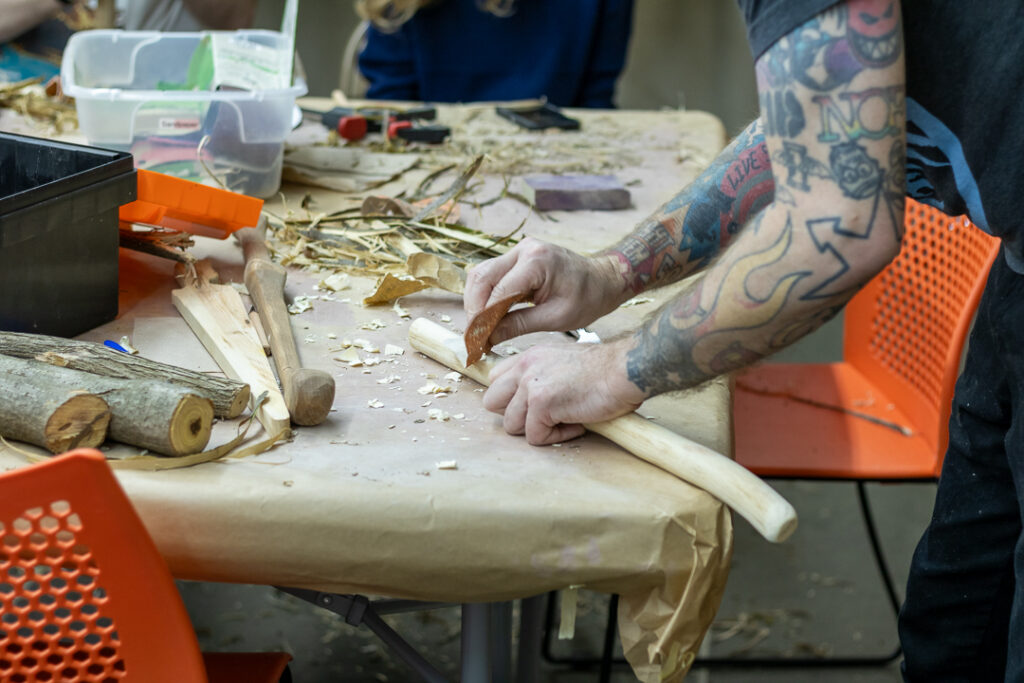
ARI is making one of history’s most hands-on sciences accessible and a lot of fun.
Most people picture archaeology as something that happens far away, in a desert, with a whisk broom and a lot of patience, but there’s a branch of the field that looks a little different. It’s one where you’re standing around a fire, processing tree sap, or learning to throw a spear with the same mechanics people used thousands of years ago. It’s called experimental archaeology, and The Archaeological Research Institute (ARI) is bringing it to you.
Experimental archaeology is a research methodology built on recreating ancient tools, techniques, and processes to understand them from the inside out. Instead of just studying a stone-tipped spear in a glass case, you might ask: how was that tip attached to the handle? What adhesive did they use? How far could it actually be thrown? These questions often can’t be answered by observation alone. Experimental archaeology fills that gap.
By replicating ancient processes, researchers and participants gain insights into engineering, decision-making, and cultural knowledge through a direct window into the ingenuity of past cultures. It turns artifacts from silent objects into living technologies, and it reveals just how sophisticated ancient problem-solving really was.
At ARI, experimental archaeology is part of our core research, but we’ve always believed the best discoveries happen when the public gets to be part of them. That’s why we’ve built a series of hands-on workshops where anyone can step into the role of scientist and explorer, with no prior experience required.
ARI offers two ways to get involved. You can join one of our public workshops and events held throughout the year, or you can book a private indoor experience at ARI Base Camp for your group, family, classroom, or organization.
This is a great option for home school co-ops, scout troops, birthday parties with a curious streak, or corporate team-building that teaches something.
Either way, you’ll leave with something you made with your own hands and a completely new appreciation for the people who made these tools thousands of years ago.
This past season, we brought that experience to our community through three workshops at ARI Base Camp. Here’s a look at what each one uncovered.
Before super glue, before epoxy, before tape, there was pitch.
More than 45,000 years ago, people learned to transform raw organic materials, primarily tree resin, into a reliable, versatile adhesive. This was no small feat. Pitch production requires understanding how different materials behave under heat, how ratios affect consistency and strength, and how the final product needs to perform in real-world conditions. Archaeologists consider it one of the earliest examples of composite technology: the deliberate combination of materials to produce something neither could achieve alone.
In January’s workshop, participants worked through that process firsthand. They sourced and processed raw materials, applied traditional production techniques, and produced their own functional batches of pitch adhesive.
What experimental archaeology reveals in a workshop like this isn’t just technique. It is the depth of knowledge that technique represents. This knowledge had to be developed, tested, refined, and passed down across generations. Standing over a fire and adjusting a batch that isn’t quite right, you begin to understand what that process actually required of the people who did it first.
The second workshop built directly on the first, because pitch, as participants had just learned to make, is only meaningful when you know what it’s for.
A sharp stone edge is useful. A sharp stone edge attached to a handle is a tool. Hafting is the process of joining a toolhead to a handle or shaft, and it represents one of the foundational technologies of human history. Before hafted tools, a sharpened stone edge was useful but limited. Once attached to a handle and secured with adhesive, sinew, and careful binding, that edge became a purpose-built instrument: an axe, a spear, a scraper, or a knife.
The range of what humans could make and do expanded dramatically. What’s easy to overlook, until you try it yourself, is how much engineering is involved.
The toolhead must be fitted precisely. The binding must account for the movement and stress the tool will experience in use. The adhesive must be applied correctly to hold under pressure without making the joint brittle.
Different cultures developed different solutions to these challenges, and the variety of hafting techniques preserved in the archaeological record reflects an extraordinary range of creative problem-solving.
In February’s workshop, participants worked through those challenges directly by preparing materials, fitting toolheads, and applying traditional binding and lashing techniques to produce their own hafted tools. The process demanded patience and precision, and that experience itself is part of what experimental archaeology offers.
When you feel how difficult it is to get a hafted tool right, you understand why the skill was so valued, and why the finest examples in the archaeological record were so carefully made.
The third workshop introduced participants to the atlatl, a word most had never encountered before.
An atlatl (say it: AT-lat-ul) is a spear-thrower: a handheld device that functions as a mechanical extension of the arm, using leverage to dramatically increase the speed, distance, and accuracy of a thrown projectile. The technology is at least 17,000 years old, appears on nearly every inhabited continent, and predates the bow and arrow by thousands of years. It goes by different names in different traditions, such as the woomera in Australia, but the underlying physics is the same across cultures: a longer lever transfers more energy, and the results are striking.
What makes the atlatl such a compelling subject for experimental archaeology is the gap between its apparent simplicity and its actual sophistication. A finished atlatl looks, at a glance, like a shaped piece of wood with a notch at one end. However, the design decisions embedded in that object (length, weight distribution, flex, grip geometry, hook placement) each affect performance in ways that only become apparent through use.
Different cultures arrived at different solutions, and studying those variations tells us a great deal about regional environments, hunting strategies, and the transmission of technical knowledge across time and distance.
In March’s workshop, participants crafted their own atlatls, working through those design decisions with guidance and hands-on experimentation. By the end of the session, each person had a functional spear-thrower and a much richer understanding of the ingenuity required to develop one from scratch.
Across all three workshops, a common thread emerged: experimental archaeology has a way of making ancient people feel less distant.
When you’re working with the same materials, facing the same challenges, and arriving at some of the same hard-won solutions, the people who left these tools behind stop feeling so abstract. That’s precisely why ARI invests in this work. Our mission is to help people connect with the past in ways that are meaningful, intellectually honest, and genuinely engaging.
Experimental archaeology does all three. It brings rigorous research methodology into a format that’s accessible to anyone willing to show up and get their hands dirty, and it consistently produces moments of real discovery. We’re proud of what this series offered our community, and we’re already looking ahead to what comes next.
Whether you’re a parent looking for something genuinely different to do with your kids, a collector or educator wanting a deeper context for the past, a college student exploring a new field, or just someone who has always wondered how people actually lived before modern tools, there’s a place for you in an ARI workshop.
Book an indoor experience for adults or kids, register for an upcoming workshop, or become a member today.
Come get your hands dirty. History is waiting.
University and School Partnerships
Interested in sending your students to our field school? Contact us today to learn about one of our many opportunities for student learning.