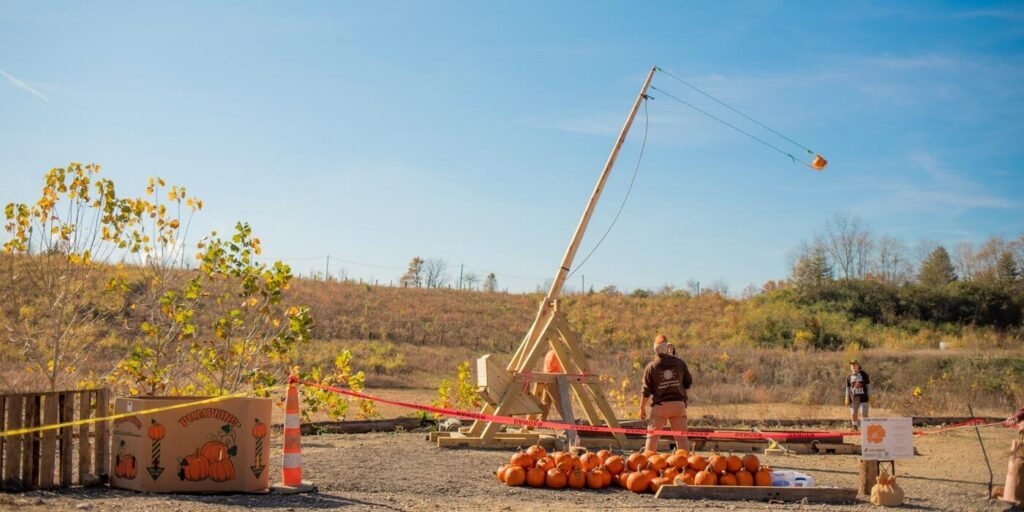
What does it take to send a pumpkin soaring across a field? At the Archaeological Research Institute (ARI), the answer involves a 19-foot trebuchet, a little gravity, and a whole lot of physics.
Our trebuchet is one of the biggest attractions at our annual Pumpkin STEM Fall Festival near Lawrenceburg, Indiana, where we put science into action by sending pumpkins flying across the field. Trebuchets have been launching heavy objects for centuries, and as it turns out, pumpkins fly pretty well, too. But when one takes flight, there’s a lot more happening than meets the eye.
A trebuchet is a large machine designed to launch heavy objects over long distances. With a tall frame and a long throwing arm stretching across the top, it’s hard to miss. Hundreds of years ago, trebuchets were used during battles to throw rocks and other objects. Today, ours has a much more fun job: launching pumpkins.
So, how does a trebuchet work? Think of that long throwing arm like a giant seesaw. A heavy counterweight sits on one end, and the sling holding the pumpkin hangs from the other. When the counterweight drops, the other end swings upward, carrying the pumpkin with it. At just the right moment, the sling releases, and the pumpkin goes flying.
The fun part is watching the pumpkin fly, but the really interesting part starts before it ever leaves the ground.
Raising the heavy counterweight stores energy in the trebuchet. When that weight drops, the stored energy helps swing the throwing arm and send the pumpkin up and away. From there, the pumpkin keeps moving forward while gravity pulls it back toward the ground, ending every launch with a landing (and a pretty satisfying splat).
And because every part of the launch works together, even a small change can send the pumpkin on a very different flight.
That’s where the experimenting begins. Before a launch, you can make a prediction: How far will the pumpkin go? Then you can watch what happens, compare the result with your prediction, and start asking why.
Change the counterweight, adjust the launch, and you might get a completely different result. Each attempt gives you another chance to test an idea and figure out what sent the pumpkin farther, higher, or in a different direction.
That kind of learning doesn’t have to stop when the pumpkins crash back down to earth. At our Hands on History: Trebuchet workshop on October 10, participants ages 14 and older can take a closer look at how trebuchets operate and learn about their engineering, maintenance, and history.
Ready to see what all that science can do to a pumpkin? If you’re looking for something different to do with the family near Lawrenceburg, Indiana, join us at the Pumpkin STEM Fall Festival on Saturday, November 7, 2026, from 11 a.m.–6 p.m. at Carriage House Farm in North Bend, Ohio. General admission is free.
Come for the flying pumpkins, then stay for a full day of hands-on family fun. Try your hand at an atlatl, explore the Kids Zone, or catch historical and LEGO League demonstrations. You’ll also find local artisans, food, and live music throughout the day.
Bring the family and see our 19-foot trebuchet take center stage!
University and School Partnerships
Interested in sending your students to our field school? Contact us today to learn about one of our many opportunities for student learning.